Something bothered me with something John Atkinson said in his review, but it wasn't until a re-read of Peter Craven's paper that I realized what it was:
On the face of it, however, this improvement seems paradoxical: the preresponse comprises ringing at half the sample rate (called the Nyquist Frequency), which, even with CD, is above the limit of human hearing. But the preresponse does appear to have an audible effect, perhaps because the human ear/brain system acts as a wavefront detector rather than as a spectrum analyzer.
John is mistaken and hasn't understood the problem fully. He notes, correctly, that the ringing occurs at the Nyquist frequency or 22.05kHz or 24kHz, but he's failed to appreciate that the
ringing introduced by a brick-wall filter occurs at all frequencies present in the input signal and that it is the
amplitudes of all these frequencies which modulate at the Nyquist frequency. It's the linear phase nature of the brick-wall filter which results in all frequencies modulating at the same (Nyquist) frequency. Ringing is therefore quite audible to human hearing, because it occurs at all frequencies present in the source; there is no paradox as stated.
Edit: Here's a picture of the typical impulse response of a brick-wall filter which plots the response amplitude for all frequencies (y-axis) vs. time (x-axis):
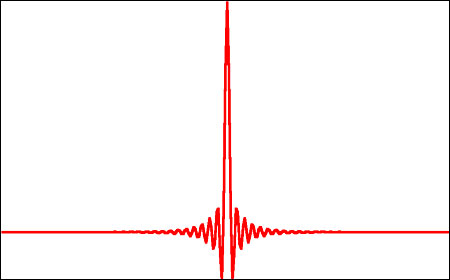
Note the pre-ringing and post-ringing either side of the main (peak) response. Although the response varies in amplitude, the frequency of the response is the Nyquist frequency throughout.
 Google Search
|
Meridian Systems
|
Meridian Streaming
|
Restaurant
|
WiKi
|
Duncan's Meridian Info
|
Board Rules
|
Restaurant Rules


