|
|
Joined: Jul 2007
Posts: 687 Likes: 2
Paranoid android
|
|
Paranoid android
Joined: Jul 2007
Posts: 687 Likes: 2 |
I haven't listened to the 808.2. Did get a chance at the 7200 and was very impressed. But I'm wondering about the rave review of a system without MRC. I've found it to be quite the answer in my room.
Roon, Technics SL10 turntable, Meridian 218, Jolida tube DAC, Nuforce STA 200 Amp and passive Swallow Acoustics ALS2 speakers
|
|
|
|
|
Joined: Feb 2008
Posts: 1,941 Likes: 9
Knows where his towel is
|
|
Knows where his towel is
Joined: Feb 2008
Posts: 1,941 Likes: 9 |
I wonder when the combined review of the 808i.2 and 7200 will be out. We do not often get reviews of players and speakers combined i.e. operating at their optimum.
Also, thanks to the wonderful posts from SSpears, I learn we are now more in a world of BIPS than MIPS. When will our Meridian gear get them? More retrofit opportunities?
Asa Post
|
|
|
|
|
Joined: Apr 2007
Posts: 291
Hitchhiker
|
|
Hitchhiker
Joined: Apr 2007
Posts: 291 |
I wonder when the combined review of the 808i.2 and 7200 will be out. We do not often get reviews of players and speakers combined i.e. operating at their optimum.
Also, thanks to the wonderful posts from SSpears, I learn we are now more in a world of BIPS than MIPS. When will our Meridian gear get them? More retrofit opportunities? Toneaudio had one of the 808i.2 and 7200. howie
Avid Acutus, SME V, Benz Micro LP / Van den Hul Colibri XGP, Audio Research Ref 2 Phono
Meridian Sooloos C15 + MD600
CH Precision C1 DAC
Constellation Audio Virgo and Centaur Monoblocks
Sonus Faber Aida
|
|
|
|
|
Joined: Feb 2008
Posts: 1,941 Likes: 9
Knows where his towel is
|
|
Knows where his towel is
Joined: Feb 2008
Posts: 1,941 Likes: 9 |
Howie
Can you please post the link?
Asa Post
|
|
|
|
|
Joined: Jul 2004
Posts: 1,870 Likes: 13
Knows where his towel is
|
|
Knows where his towel is
Joined: Jul 2004
Posts: 1,870 Likes: 13 |
Evening, You can find it on Duncan's site under DSP7200
Regards
Under review
|
|
|
|
|
Joined: Feb 2008
Posts: 1,941 Likes: 9
Knows where his towel is
|
|
Knows where his towel is
Joined: Feb 2008
Posts: 1,941 Likes: 9 |
Asa Post
|
|
|
|
|
Joined: Apr 2007
Posts: 291
Hitchhiker
|
|
Hitchhiker
Joined: Apr 2007
Posts: 291 |
Sorry didn't check in for a while Glad to see someone got the link to you.
howie
Avid Acutus, SME V, Benz Micro LP / Van den Hul Colibri XGP, Audio Research Ref 2 Phono
Meridian Sooloos C15 + MD600
CH Precision C1 DAC
Constellation Audio Virgo and Centaur Monoblocks
Sonus Faber Aida
|
|
|
|
|
Joined: Apr 2004
Posts: 12,733 Likes: 88
Don't Panic!
|
|
Don't Panic!
Joined: Apr 2004
Posts: 12,733 Likes: 88 |
Something bothered me with something John Atkinson said in his review, but it wasn't until a re-read of Peter Craven's paper that I realized what it was: On the face of it, however, this improvement seems paradoxical: the preresponse comprises ringing at half the sample rate (called the Nyquist Frequency), which, even with CD, is above the limit of human hearing. But the preresponse does appear to have an audible effect, perhaps because the human ear/brain system acts as a wavefront detector rather than as a spectrum analyzer. John is mistaken and hasn't understood the problem fully. He notes, correctly, that the ringing occurs at the Nyquist frequency or 22.05kHz or 24kHz, but he's failed to appreciate that the ringing introduced by a brick-wall filter occurs at all frequencies present in the input signal and that it is the amplitudes of all these frequencies which modulate at the Nyquist frequency. It's the linear phase nature of the brick-wall filter which results in all frequencies modulating at the same (Nyquist) frequency. Ringing is therefore quite audible to human hearing, because it occurs at all frequencies present in the source; there is no paradox as stated. Edit: Here's a picture of the typical impulse response of a brick-wall filter which plots the response amplitude for all frequencies (y-axis) vs. time (x-axis): 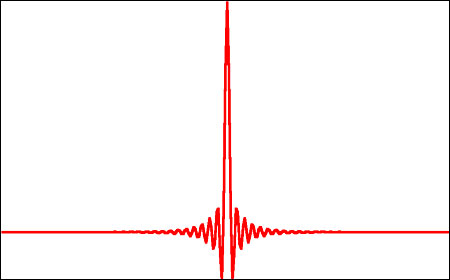 Note the pre-ringing and post-ringing either side of the main (peak) response. Although the response varies in amplitude, the frequency of the response is the Nyquist frequency throughout.
Last edited by VirusKiller; 2009-05-03 16:34.
|
|
|
|
|
Joined: Jun 2009
Posts: 16
Luminary from another Galaxy... Harmless
|
|
Luminary from another Galaxy... Harmless
Joined: Jun 2009
Posts: 16 |
BTW, you must upsample to do apodising, or any digital anti-aliasing filtering, because the filter knee is so close to the Nyquist frequency. Whether you speak of the filtering being applied after upsampling, or as part of the upsampling process, is really a matter of semantics. From the perspective of upsampling the original digital signal, you must upsample in order to filter, and you must filter if you upsample. Actually that's not the case. One of the things that we evaluated in our listening tests was a filterless ("non-oversampling") DAC. It was interesting but also had some problems. So we tried adding a notch filter at 22.05 kHz to remove any "ringing" that was present from upstream in the record/playback chain. This can easily be done without oversampling. To our ears it made virtually no change to the sound whatsoever. But that is another story altogether... Charles Hansen Ayre Acoustics, Inc.
|
|
|
|
|
Joined: Jun 2009
Posts: 16
Luminary from another Galaxy... Harmless
|
|
Luminary from another Galaxy... Harmless
Joined: Jun 2009
Posts: 16 |
Something bothered me with something John Atkinson said in his review, but it wasn't until a re-read of Peter Craven's paper that I realized what it was: On the face of it, however, this improvement seems paradoxical: the preresponse comprises ringing at half the sample rate (called the Nyquist Frequency), which, even with CD, is above the limit of human hearing. But the preresponse does appear to have an audible effect, perhaps because the human ear/brain system acts as a wavefront detector rather than as a spectrum analyzer. John is mistaken and hasn't understood the problem fully. He notes, correctly, that the ringing occurs at the Nyquist frequency or 22.05kHz or 24kHz, but he's failed to appreciate that the ringing introduced by a brick-wall filter occurs at all frequencies present in the input signal and that it is the amplitudes of all these frequencies which modulate at the Nyquist frequency. It's the linear phase nature of the brick-wall filter which results in all frequencies modulating at the same (Nyquist) frequency. Ringing is therefore quite audible to human hearing, because it occurs at all frequencies present in the source; there is no paradox as stated. Edit: Here's a picture of the typical impulse response of a brick-wall filter which plots the response amplitude for all frequencies (y-axis) vs. time (x-axis): Note the pre-ringing and post-ringing either side of the main (peak) response. Although the response varies in amplitude, the frequency of the response is the Nyquist frequency throughout. Not sure I agree with your criticism of JA's article. You are correct that the ringing occurs when any transient passes through the filter. However, it is not the fact that the filter is linear phase that has them ring at the Nyquist frequency. Any filter with a rolloff steeper than 6 dB per octave will ring -- at its cutoff frequency. The sharper the knee, the more it will ring. A filter rings at the Nyquist frequency (which is simply half of the sampling frequency) of a digital audio record/playback system because the designers used filters that had a cutoff frequency of 22.05 kHz. This is true whether the filter is linear phase, minimum phase, or any phase. Charles Hansen Ayre Acoustics, Inc.
|
|
|
|
|
Joined: Apr 2004
Posts: 12,733 Likes: 88
Don't Panic!
|
|
Don't Panic!
Joined: Apr 2004
Posts: 12,733 Likes: 88 |
Thanks Charles. I did realize that minimum phase filters also ring, but what I wrote did kind of imply that it was a brick wall filter problem (which is what JA was describing).
|
|
|
|
|
Joined: Jun 2009
Posts: 16
Luminary from another Galaxy... Harmless
|
|
Luminary from another Galaxy... Harmless
Joined: Jun 2009
Posts: 16 |
Thanks Charles. I did realize that minimum phase filters also ring, but what I wrote did kind of imply that it was a brick wall filter problem (which is what JA was describing). Hi VK, My take on what JA was saying was that any ringing at 22+ kHz shouldn't be audible and he was therefore surprised that making *any* changes to that ringing -- killing it, moving it before the impulse, moving it after the impulse, whatever -- shouldn't be audible. So I think he was surprised by the improvement made by Meridian's filter, which in theory shouldn't make any *audible* difference. Especially for those who are old enough that we can't hear past 20 kHz anymore... But theory and practice are two different things. I've heard a clear difference by changing the bandwidth of a power amp from 150 kHz to 250 kHz. And the really weird thing is that we had to extend the bandwidth of that design to 250 kHz to get it to sound as extended and open as a different design with a 100 kHz bandwidth. Go figure.... Cheers, Charles Hansen Ayre Acoustics, Inc.
|
|
|
|
2 members (Rick7, Stebbo),
1,139
guests, and
2
robots. |
|
Key:
Admin,
Global Mod,
Mod
|
|
|
Forums18
Topics31,247
Posts297,411
Members5,503
| |
Most Online4,788
May 22nd, 2026
|
|
|
|
 Google Search
|
Meridian Systems
|
Meridian Streaming
|
Restaurant
|
WiKi
|
Duncan's Meridian Info
|
Board Rules
|
Restaurant Rules


